A second way of seeing a room
A room is usually a background. I enter it to work, read, put something away, or rest. Its temperature and brightness matter, but mostly as conditions surrounding another activity. Unless I feel uncomfortable or cannot see clearly, I have little reason to notice them.
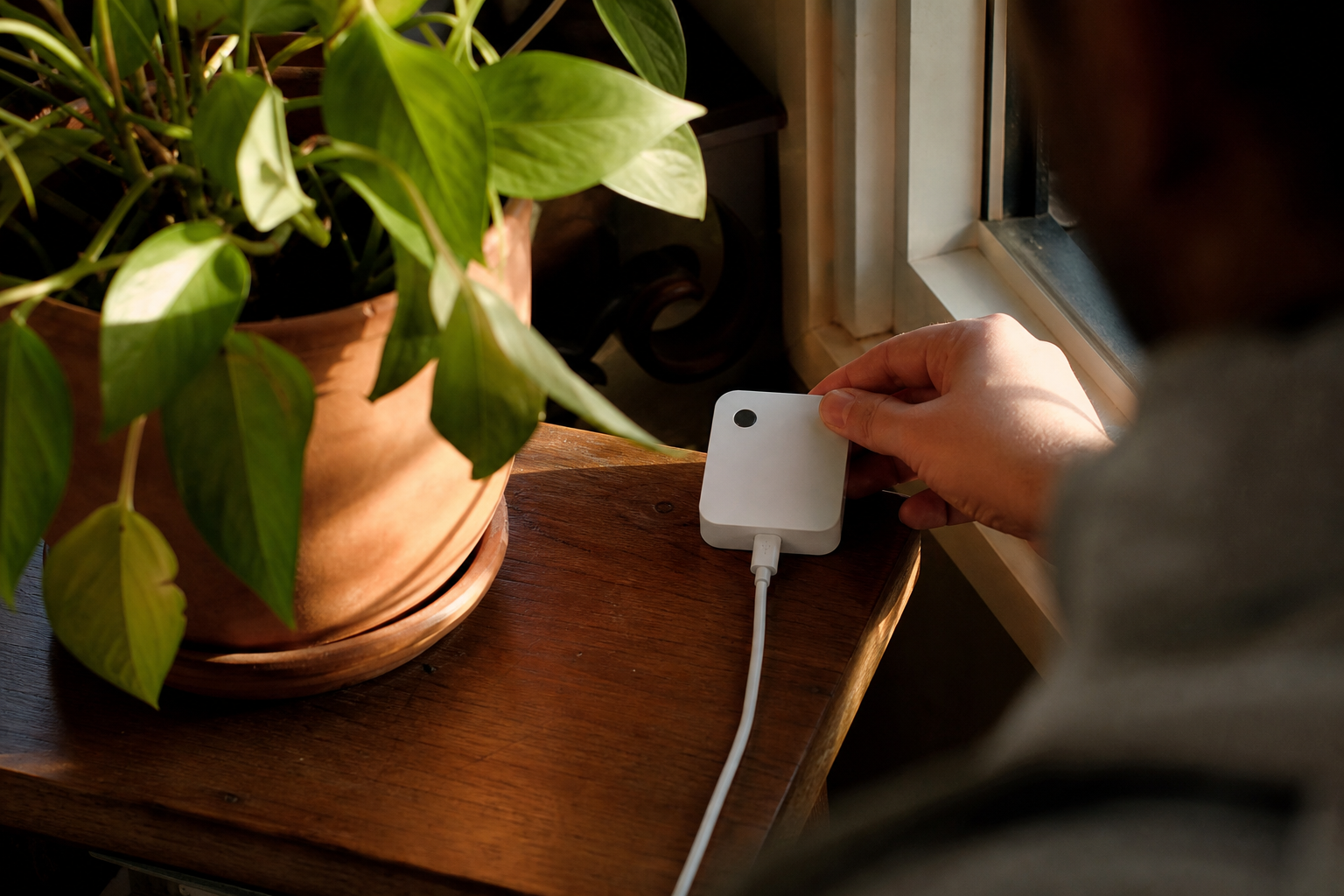
Placing a small sensor in that room changes its role slightly. The furniture remains where it was. The window still faces the same direction. Yet a number that rises and falls gives me another way to perceive the place. What seemed like a stable container for daily life begins to appear as a collection of changes unfolding at different speeds.
This is one of the things I find appealing about technology becoming available for home use. A gadget does not have to perform a remarkable task to be interesting. It can simply make something ordinary available for closer observation. A temperature sensor or light sensor offers a modest arrangement: one room, one measurement, and enough time to notice a pattern.
I tend to imagine scientific curiosity beginning somewhere distant, with equipment I cannot obtain or knowledge I do not yet possess. A sensor on a shelf suggests a smaller starting point. The place is already here. What changes is the means of paying attention.
The number is not the room
There is something reassuring about a digital display. A room described as slightly warm sounds subjective; a temperature written to one decimal place appears settled. But the neatness of the display can conceal the untidiness of the measurement.
A temperature sensor measures conditions at its own location, within the limits of its design. Beside a sunlit window, near an air outlet, or close to a warm electronic device, it may report something different from a sensor on the opposite wall. Direct sunlight can warm the sensor itself. Its response may also lag behind a change in the surrounding air.
Similarly, a light sensor does not simply report how bright the room feels to me. Its orientation matters, as do shadows, reflections, and the wavelengths to which it responds. A basic device may be more useful for comparing changes at one fixed position than for making precise claims about illumination throughout the room.
I do not find these limitations disappointing. They are part of what makes the device interesting. The number becomes more informative when I remember how it was obtained.
There is a useful distinction here between resolution and accuracy. A display may show small increments without being equally accurate. More digits do not, by themselves, establish a closer agreement with reality. I would rather begin with a rough understanding of the instrument than borrow confidence from its decimal places.
A small observatory on a shelf
The history of scientific instruments includes many ways of extending ordinary perception. A telescope gathers light that the unaided eye cannot gather in the same way. A microscope makes small structures visible. A thermometer gives a repeatable scale to something the body experiences less consistently.
A household sensor belongs to that broad family, even if its surroundings are a desk, a curtain, and a charging cable. The scale is smaller than a laboratory, but the basic movement is familiar: an instrument makes a difference visible, and that difference gives thought somewhere to begin.
I like the idea of a room becoming a small observatory without becoming a renovation project. The first experiment could be deliberately uneventful. I could leave one temperature sensor in a shaded location, record its readings over several days, and keep a brief note of ordinary events: a window opened, a door closed, an appliance used.
The purpose would not be to prove a theory immediately. It would be to find out what kind of variation is present. A room that feels approximately the same across an afternoon might show a slow rise in temperature. Another might change quickly and then settle. Either pattern would make the familiar place a little more specific.
That seems a sufficient reward for an inexpensive gadget. It would not need to make the house intelligent. It could first help me become more attentive to one corner of it.
From a trace to an explanation
Once a sensor produces a graph, explanation becomes tempting. A line rises after a curtain is opened, and a story is ready. Sunlight entered; the room warmed. The story may be reasonable, but the graph alone does not establish every part of it.
Perhaps the sensor received direct sunlight while much of the room changed less. Perhaps outdoor conditions were changing at the same time. Perhaps another source of heat was operating. A single trace can suggest a cause without separating it from the other things happening nearby.
This is where a small home experiment can teach something beyond the behavior of a room. It gives me practice in keeping observation and interpretation apart. I can write that the reading increased after a particular event, then leave the explanation provisional.
If I wanted to examine the curtain more carefully, I could compare several roughly similar periods while keeping the sensor in the same position. The comparison would remain imperfect. A home is not a controlled laboratory, and the weather does not arrange itself around my curiosity. Still, a modest comparison might be more informative than a confident explanation based on one afternoon.
I would also want to decide on the arrangement before collecting the readings. This connects with a habit I am trying to develop elsewhere: separating the time for thinking from the time for carrying out a plan. Choosing the location, interval, and notes in advance would let me observe without repeatedly redesigning the experiment. Later, I could return to the decisions with something concrete to examine.
Leaving room for curiosity
There is an obvious practical direction for all this. Sensors can help inform heating, lighting, ventilation, and other household routines. Those uses interest me, but I would not want usefulness to become an entrance requirement for every small experiment.
A light reading might reveal how strongly a passing cloud changes conditions near a window. A temperature record might make the slow release of warmth after sunset more noticeable. Neither observation needs to lead directly to an automation rule or a more efficient schedule. Understanding a little more about the place where I spend my time has value of its own.
I can also see how easily the equipment could become the main occupation. There would be another sensor to compare, another display to configure, another chart to adjust. Some of that would be enjoyable. But I would like to preserve a distinction between playing with the apparatus and observing what it reveals. Both can be worthwhile, provided I know which activity I am doing.
For a beginning, one device and one changing quantity seem enough. I would prefer a few readings that I actually consider to a large archive that I rarely open. Even a short note about an unexpected change could give the experiment continuity without turning it into a duty.
The appeal, finally, is not that the room contains a hidden answer waiting for the correct gadget. It is that a familiar place can support more attention than I usually give it. A small sensor makes one part of that place newly visible. From there, curiosity has something ordinary and tangible to work with.