A Simple Task Seen from Outside
When I imagine building a small robot, I tend to picture the finished movement first. An arm reaches across a table, its gripper closes around an object, and the object rises. The scene takes only a moment in my mind. It looks like a modest project, perhaps something that could sit beside a computer.
But the movement becomes less simple as soon as I try to describe how it would happen. The robot needs to approach from a suitable direction, make contact without pushing the object away, apply enough force to hold it, and lift without losing its grip. Each part depends on the others. The shape of the gripper affects the approach. The surface of the object affects the force. The weight changes what happens after the lift begins.
I find two kinds of curiosity meeting here. One concerns the machine I might build. The other concerns the body I already have. Trying to give a robot a small ability makes that same ability in my own hand newly visible. Building a machine can become a way of looking back at the person building it.
What the Hand Quietly Takes Into Account
A hand does not meet every object in the same way. A cup offers a rim, a handle, and a curved outer surface. A folded cloth changes shape as it is grasped. A small box may be easy to hold from two sides, yet awkward to approach if other things are close beside it. Even before contact, there are choices about where the fingers should go and how the wrist should turn.
I rarely experience these as separate decisions. I simply reach for something. My attention is usually on what I intend to do afterward: drink, put something away, move on to another task. The grasp itself remains in the background unless something slips or feels unexpectedly heavy.
For a robot, those background details have to be addressed somehow. They may be handled by a program, by sensors, by the mechanical design, or by narrowing the task so that fewer adjustments are necessary. A gripper built for one object in a known position can be quite different from a hand expected to pick up unfamiliar things from a crowded table.
That distinction interests me. The apparent simplicity of an action depends partly on how much variation has been removed from the situation. If I place the same block in the same spot each time, I have already done some of the work for the robot. There is nothing disappointing about that. It gives me a clearer account of what the machine can do and what the arrangement around it is doing on its behalf.
It also makes me more attentive to my own movements. Human grasping draws on vision, touch, and a sense of the body’s position. These sources of information overlap. I do not need to watch every finger throughout an ordinary reach, yet I can often feel that an object is beginning to move within my grip.
Some Intelligence Is in the Material
At first, I am inclined to think of robotics mainly as a programming problem. If a movement is awkward, perhaps the instructions need to be better. Yet a gripper offers a useful reminder that the physical construction can solve problems before software becomes involved.
Two hard, smooth surfaces may struggle to hold an object that slightly softer pads can grasp with less precision. A little compliance—the ability to yield under pressure—can help contact settle across an uneven surface. A curved finger can support an object differently from a flat one. The shape and material influence how much sensing and adjustment the rest of the system needs.
A pair of kitchen tongs is a modest example. It does not calculate the outline of the thing being held. Its usefulness comes partly from leverage, the shape of its ends, and the way it flexes under the hand. Looking at such a tool beside a robotic gripper makes the distance between everyday objects and robotics feel smaller.
The human hand also has yielding surfaces, moving joints, and a structure that changes shape around objects. That is not a complete explanation of its abilities, but it suggests why treating a hand as a set of rigid levers would leave so much out. Control and construction work together.
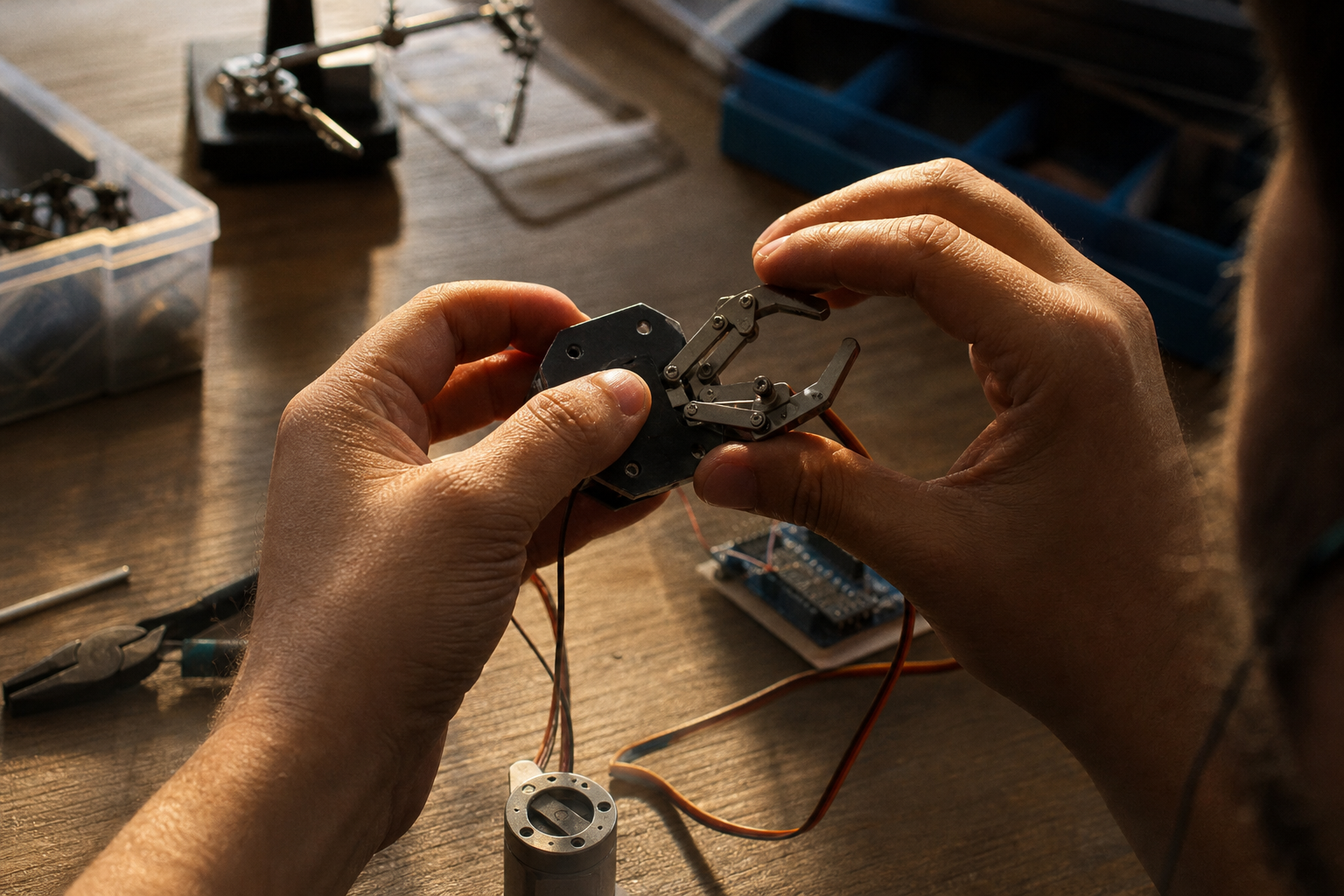
This is one reason I enjoy the thought of combining a 3D printer with small electronic components. A change on the screen can become a different curve, a wider contact surface, or a finger that bends in another place. The experiment need not begin with a sophisticated machine. It can begin with discovering that a small change in shape makes an uncertain grasp a little more stable.
The Moment After Contact
Closing the gripper is not quite the same as holding the object. Before a lift, the table supports the object’s weight. As the object leaves the surface, that support disappears. A grasp that looked adequate while everything rested on the table may turn out to be too loose, poorly balanced, or vulnerable to rotation.
This makes the moment after contact especially interesting to me. A command such as “close, then lift” describes a sequence, but it does not say whether the sequence is succeeding. Feedback supplies information about what is actually happening. Depending on the design, that information might come from position, force, motor current, or an image. Each reveals something different, and each has limits.
Motor current, for example, may suggest that a mechanism is encountering resistance, but it is not the same as directly knowing the force at a fingertip. A camera may show an object moving while missing details hidden between the gripping surfaces. Adding a sensor does not remove the need to understand what its signal means.
I sometimes think “robot hand” and immediately picture more fingers, more joints, and more complicated control. That picture can make the project feel beyond me before I have started. A more useful first experiment would be much narrower: a light, unbreakable object, a known starting position, and a slow lift just above the surface.
In that setting, a failed grasp could become specific rather than discouraging. The object might slide, twist, or get pushed aside during the approach. Those are different events. Instead of concluding that grasping is too difficult, I could begin to see which part of this particular grasp needs attention. The whole problem would still be large, but the next experiment could remain small.
Returning from the Machine to the Body
AI fits naturally into this kind of exploration for me. I think of it as an extension of my working notes: a place to organize the parts of the problem, examine a control sequence, or work through an unfamiliar piece of code. It can help turn a vague intention into a design that is concrete enough to test.
But a description of a gripper does not yet contain the feel of its movement. Dimensions have to fit. Materials behave in particular ways. A mechanism may bind where a drawing looked clear. I look forward to that passage from explanation to object, where an idea acquires weight and resistance and begins to answer back through its behavior.
I also want to keep the comparison with the human body modest. A small robot would not be a complete model of a hand, and making it grasp a block would not explain human movement as a whole. What it could offer is a different viewing angle. Friction, balance, contact, and adjustment would become easier to notice because I had tried to arrange them elsewhere.
There is a quiet pleasure in that reversal. I begin by wanting to make something move, then find myself paying closer attention to movements I had taken for granted. Picking up a cup becomes a little less ordinary—not because it has become mysterious, but because some of its hidden work has come into view.
The robot I would like to build need not resemble a person very closely. Two fingers and a limited task might be enough for a beginning. What draws me toward it is the chance to make an idea tangible, and then return from the workbench with a slightly different understanding of my own hand.